
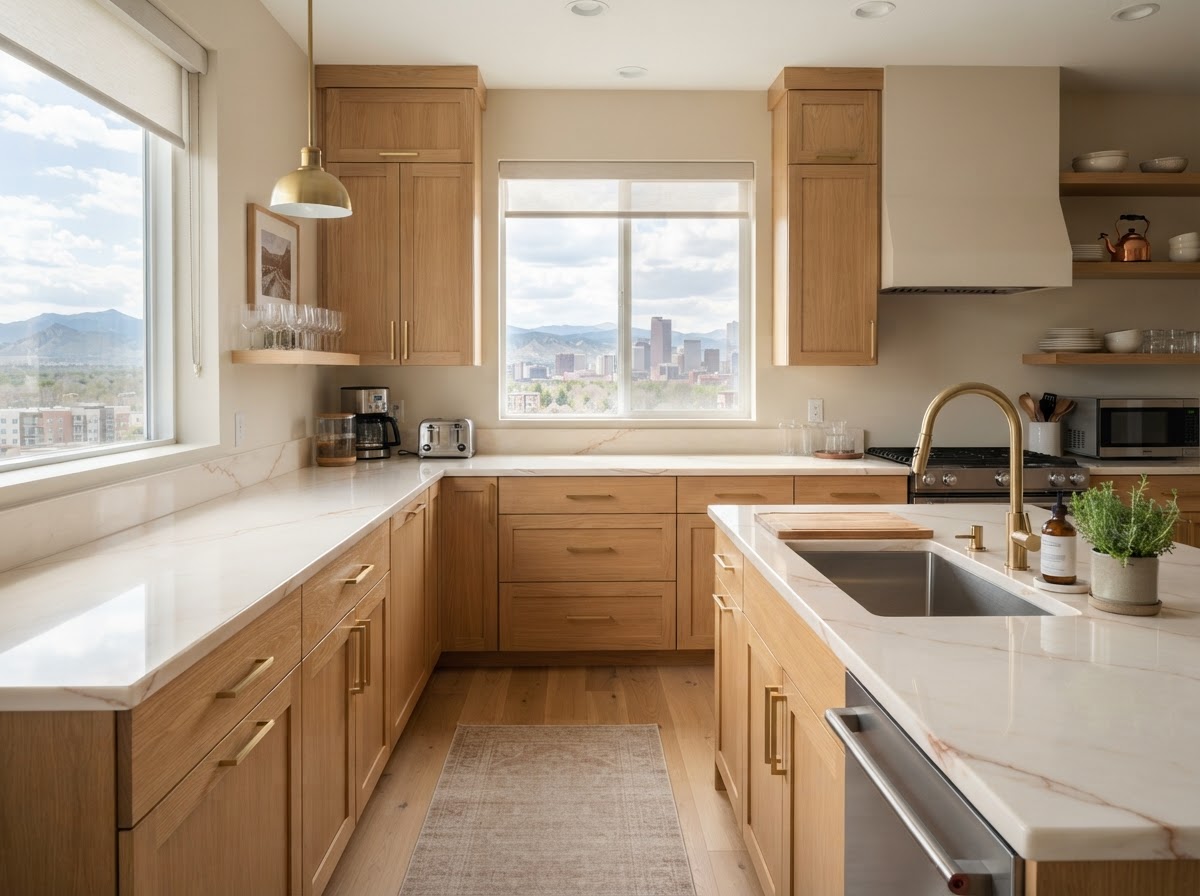
Your layout works. Your countertops do not. FlowStone creates a custom-poured resin surface over suitable existing countertops, designed around your cabinets, flooring, lighting, and personal style with less demolition and disruption than a full replacement.
Best for: Homeowners whose countertop layout still works but whose existing surface is dated, unattractive, or disconnected from the rest of the room.
Change the Surface Without Rebuilding the Kitchen
A dated countertop can make an otherwise functional kitchen feel unfinished. The cabinets may still work. The layout may still work. The countertops are what no longer belong.
Conventional replacement adds demolition, disposal, plumbing coordination, fabrication, and installation. That disruption makes sense when the existing countertop is damaged or the layout needs to change. It may not be necessary when the underlying surface is still sound.
FlowStone offers another path. We carefully prepare the existing countertop and create a custom resin surface over it, giving you control over the color, movement, veining, and finish.
Is Resurfacing Right for Your Kitchen?
Resurfacing may be a strong option if:
- Your existing countertops are firmly bonded and structurally stable
- You like the current layout and your cabinets are staying
- You want a completely different appearance
- You want more design freedom than prefabricated slabs provide
- You want to reduce unnecessary demolition, disposal, and disruption
Every countertop is evaluated before FlowStone recommends resurfacing. If the existing surface should be repaired or replaced instead, we will tell you directly.
Which Countertops Can Be Resurfaced?
Often Suitable
- Firmly bonded laminate in stable condition
- Well-adhered tile with grout lines that can be properly leveled
- Cultured marble, wood, concrete, or existing stone when technically appropriate
- Dry, structurally stable substrates without movement
May Require Repair or Replacement
- Moisture damage, swelling, deterioration, or rot
- Loose tile, failed seams, or visible movement
- Structural weakness that preparation cannot correct
- Contamination or surface conditions that prevent dependable adhesion
- Sink, edge, or transition conditions that cannot be properly integrated
Suitability is reviewed through photographs first and confirmed during an on-site inspection.
Resurfacing Compared With Full Countertop Replacement
Neither option is right for every kitchen. The condition of your countertops, the layout, and what you want to change determine the better path.
| Factor | FlowStone resurfacing | Full countertop replacement |
|---|---|---|
| Demolition | Existing countertops remain when structurally suitable | Existing countertops are removed and disposed of |
| Design control | Color, movement, veining, and finish are developed for the room | Surface is selected from available slabs or manufactured patterns |
| Plumbing | Existing configurations may be retained, depending on sink and project conditions | Plumbing is generally disconnected and reconnected |
| Seams and transitions | A continuous-looking finish can reduce visible transitions when conditions allow | Seam placement is determined by slab size, layout, and fabrication |
| Heat | Requires trivets and protection from hot cookware | Natural stone and porcelain generally tolerate more heat |
| Repairability | Localized wear or damage may be repairable or renewable | Repair options depend on the material and extent of the damage |
| Best foundation | Requires a sound, stable, properly prepared substrate | Better suited to failed countertops, structural problems, and layout changes |
| Disruption | Generally less demolition, disposal, and downtime | More removal, fabrication coordination, and installation work |
Demolition
FlowStone resurfacing
Existing countertops remain when structurally suitable
Full replacement
Existing countertops are removed and disposed of
Design control
FlowStone resurfacing
Color, movement, veining, and finish are developed for the room
Full replacement
Surface is selected from available slabs or manufactured patterns
Plumbing
FlowStone resurfacing
Existing configurations may be retained, depending on sink and project conditions
Full replacement
Plumbing is generally disconnected and reconnected
Seams and transitions
FlowStone resurfacing
A continuous-looking finish can reduce visible transitions when conditions allow
Full replacement
Seam placement is determined by slab size, layout, and fabrication
Heat
FlowStone resurfacing
Requires trivets and protection from hot cookware
Full replacement
Natural stone and porcelain generally tolerate more heat
Repairability
FlowStone resurfacing
Localized wear or damage may be repairable or renewable
Full replacement
Repair options depend on the material and extent of the damage
Best foundation
FlowStone resurfacing
Requires a sound, stable, properly prepared substrate
Full replacement
Better suited to failed countertops, structural problems, and layout changes
Disruption
FlowStone resurfacing
Generally less demolition, disposal, and downtime
Full replacement
More removal, fabrication coordination, and installation work
FlowStone wins on personalization, transformation, and repairability. Replacement is usually the better choice when the existing countertop is structurally compromised or the layout needs to change.
A Surface Designed Around Your Room
Your finished countertop is designed around the room rather than selected from a warehouse rack.
- A coordinated base color, movement, veining, and finish
- A physical sample reviewed in your kitchen before installation
- A resin surface bonded to a properly prepared countertop
- Carefully detailed edges, sink openings, seams, and transitions
- An optional coordinated backsplash treatment when appropriate
Design Possibilities
Every design begins with the room. Together, we determine whether the countertop should become the focal point or provide a quieter foundation for the cabinets and other finishes.
- Movement: Quiet and stone-like, balanced, or dramatic
- Palette: Warm or cool base tones coordinated with the room
- Accents: Veining and secondary colors drawn from cabinets, flooring, backsplash, hardware, or paint
- Finish: A level of sheen selected for the design and the lighting in the room
Because color changes under different lighting, you review a physical sample in your own kitchen before approving the final design.
How Countertop Resurfacing Works
- 01
Initial Review
Send photographs and approximate measurements. We will discuss your goals, review visible conditions, and provide a realistic planning range.
- 02
On-Site Assessment and Design
We inspect the substrate, seams, edges, sink configuration, backsplash transitions, and surrounding conditions. We also coordinate the design with your cabinets, flooring, lighting, and other finishes.
- 03
Physical Sample Approval
FlowStone creates a physical sample based on the selected design direction. You review it in your kitchen before approving the final surface.
- 04
Preparation
The countertop is cleaned, degreased, abraded, repaired, and primed as required. Seams and grout lines are leveled, and the surrounding room is carefully masked and protected.
- 05
Pour and Finish
The approved color and movement are created by hand over the prepared countertop. Edges, sink openings, seams, and transitions receive detailed finishing.
- 06
Cure and Walkthrough
The resin and protective finish cure according to product requirements and conditions in the home. We explain when the countertop can be used and review cleaning, care, and protection.
What Affects the Project Schedule?
- Total surface area and number of countertop sections
- Existing substrate condition
- Required repairs and preparation
- Sink, cooktop, edge, and cutout complexity
- Number of colors and design layers
- Cure time and any required return visits
You will receive a written project schedule before work begins.
Living With a FlowStone Surface
FlowStone countertops are designed for everyday kitchen use, but they are not indestructible. Proper care protects the finish and helps the surface continue looking its best.
- Clean with mild soap and a soft cloth
- Use trivets and never place hot cookware directly on the surface
- Use cutting boards rather than cutting directly on the countertop
- Avoid abrasive cleaners and aggressive scrubbing pads
- Contact FlowStone before attempting to repair scratches or damage
Localized wear or damage may be repairable or renewable without replacing the entire countertop.
What Should I Budget?
Approximately $2,800 to $5,600
Most FlowStone kitchen resurfacing projects fall within this planning range. Final pricing depends on total surface area, existing countertop condition, required preparation and repairs, edge profiles, cutouts, sink and cooktop conditions, backsplash treatment, design complexity, and protective finish requirements.
Send photographs and approximate measurements to receive an initial planning range. After the on-site assessment and design consultation, you will receive a fixed proposal before approving the project.
Frequently asked questions
Let's Design a Surface That Belongs in Your Room
Send us photographs of your kitchen and tell us what you want to change. We will review the surface and tell you honestly whether resurfacing is the right approach.
FlowStone Countertops serves the Denver Metro area. View service areas